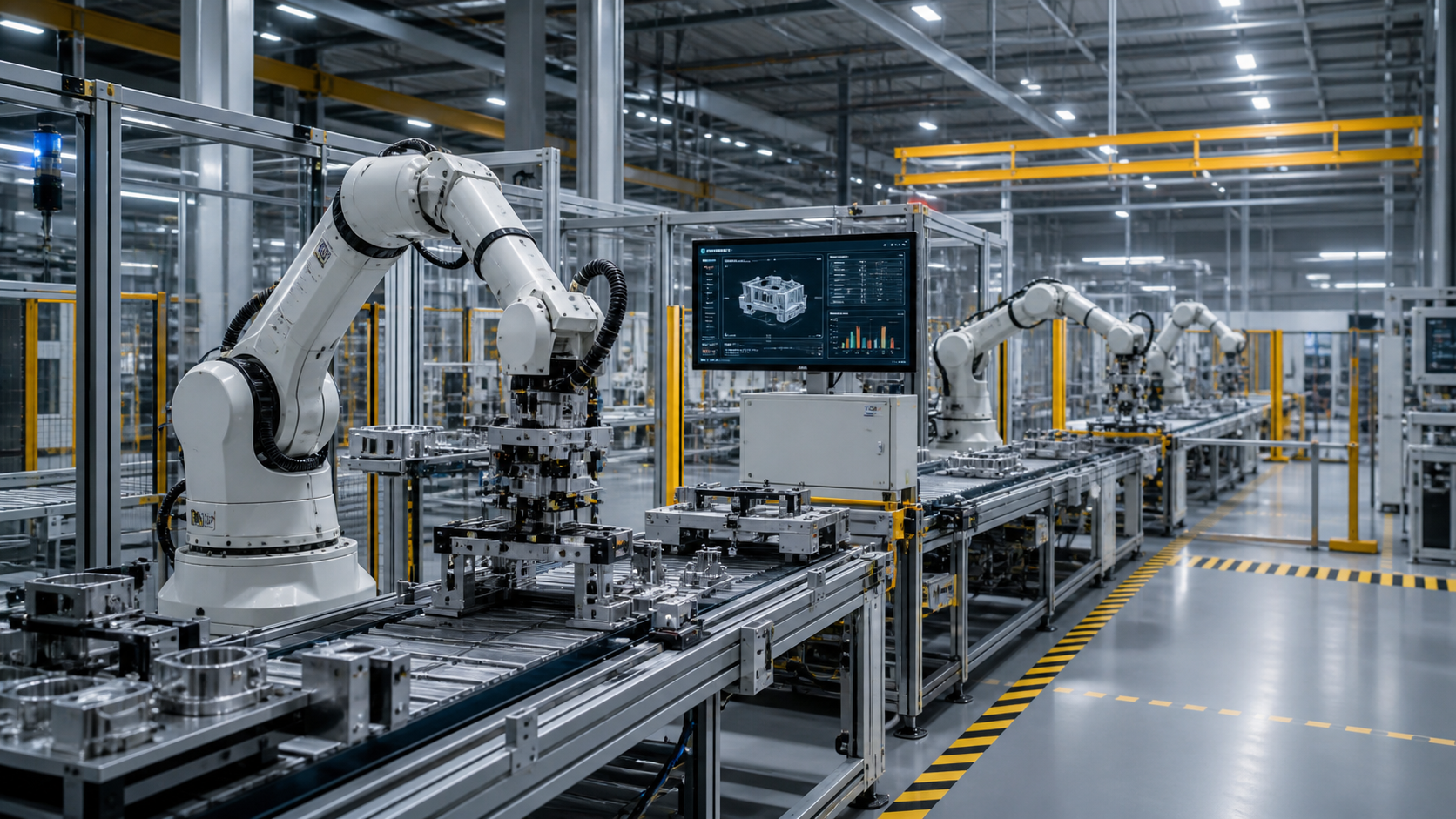
CognitioFlow sits at the controls layer — between your PLC, SCADA, and MES — and gives machines the ability to reason through a deviation instead of halting on it. Adaptive routing, exception handling, and goal-directed control, without bypassing a single safety interlock.
We start from the operating reality of each environment — the exceptions that stop a shift, not the feature list. Every solution runs the same closed loop: observe the process, reason a response, act through the existing controls, and fold the outcome back in.
Sortation jams, a missing tote, a last-minute order change. Fleet robots and sorters that re-route around the exception without stalling the floor.
View scenario →Assembly cells and machine tending that recover from part variance, a mis-fed blank, or tooling drift — instead of waiting for a reset.
View scenario →Dock scheduling, cross-docking, and parcel routing where the arrival sequence never matches the plan. Adaptive routing at the diverter.
View scenario →Process plants and remote assets that hold setpoints through a feed change or a load shift — while safety interlocks stay intact.
View scenario →Most automation is written for the day it was commissioned. CognitioFlow runs a closed loop that reads the live process state, interprets what a deviation implies downstream, chooses a response that respects every interlock, and remembers what worked.
Subscribe to the PLC tag namespace and sensor telemetry — setpoints, but also the reality on the floor.
Turn raw signals into a working picture: what's out of tolerance, and what it costs downstream if ignored.
Weigh goals, constraints, and interlocks to pick a next action — re-planning instead of halting the line.
Carry out the decision through the existing controls, then fold the outcome in so recovery gets faster.
Three operating environments, three ways the plan broke. We describe what happened and how the loop responded — no invented company names, no invented metrics.
A warehouse sortation line clears its own jam by re-routing downstream flow around the blocked divert, without a full stop.
Read the scenario → SCENARIO 02A discrete-manufacturing work-cell detects a part outside tolerance and re-sequences the operation instead of faulting out.
Read the scenario → SCENARIO 03An energy process line re-tunes its targets mid-shift as the incoming feed drifts, with interlocks untouched.
Read the scenario →CognitioFlow installs at the controls layer and talks to your existing PLCs, drives, and historians — no rip-and-replace of the automation you've already certified.
Cognitive automation is still automation. It runs inside the same functional-safety and OT-security boundaries as everything else on the floor — and the interlocks are the one thing it is never allowed to override.
We stopped trying to pre-script every exception and let the system reason instead. The first time it recovered from a pallet pattern we'd never seen — without a halt, without touching an interlock — that's when we understood what we'd been leaving on the table.
Bring a process, a PLC, and the exception that costs you the most downtime. We'll map how cognitive control changes the recovery path — no script, no slides, no invented numbers.